

Callisto: Space Innovation Tour


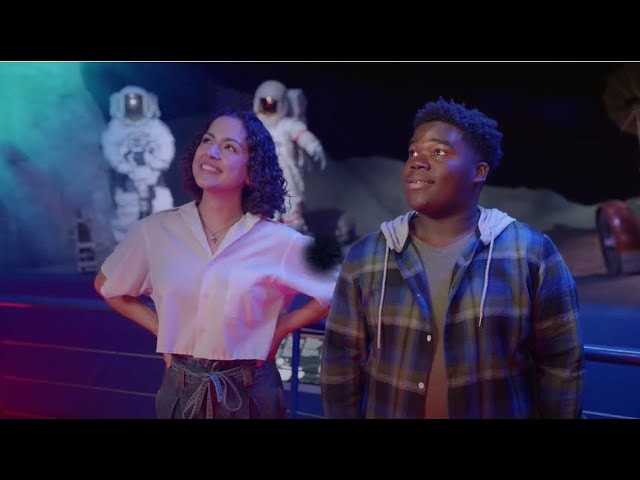
Come aboard the Orion spacecraft and discover the inner workings of new, special space technology that flew to the Moon during NASA’s Artemis I flight test.
This content is hosted by a third party.
To view the content, you need to consent to cookies by selecting Accept all in the popup banner. Or you can go to the site footer, select Cookie Preferences, and then select On under Functional Cookies.
STEM + Career-focused

Students gain exposure to the careers of the future as they discover how engineers are using science to bring voice artificial intelligence (Amazon’s Alexa), video conferencing, telemetry, and more to deep space during NASA’s Artemis I flight test.
On the tour, students will learn about Callisto, the special technology experiment that flew on board the Orion spacecraft in NASA’s Artemis I mission. Along the way students learn how we got to space, the science behind deep space communication, new telemetry displays, deep space video communication and whiteboard collaboration, voice artificial intelligence, a radiation experiment, and experience a pre-recorded live demo of the technology in action. Students also get to meet engineers from Amazon Alexa, Lockheed Martin, and Webex by Cisco that made this technology happen!
In this tour, students explore the following careers: Software Development Engineer (2), Systems Integration Test Engineer, Software Lead, Technical Leader, Technical Marketing Engineer
On the tour, students will learn about Callisto, the special technology experiment that flew on board the Orion spacecraft in NASA’s Artemis I mission. Along the way students learn how we got to space, the science behind deep space communication, new telemetry displays, deep space video communication and whiteboard collaboration, voice artificial intelligence, a radiation experiment, and experience a pre-recorded live demo of the technology in action. Students also get to meet engineers from Amazon Alexa, Lockheed Martin, and Webex by Cisco that made this technology happen!
In this tour, students explore the following careers: Software Development Engineer (2), Systems Integration Test Engineer, Software Lead, Technical Leader, Technical Marketing Engineer
Aligned to Standards

The 50 minute, interactive tour is aligned to Next Generation Science Standards (NGSS) and CSTA K-12 Computer Science Standards. The Teacher Toolkit includes a facilitation guide, worksheets, and other resources to support learning during the tour. Recommended for grades 4+.
Callisto: Space Innovation Tour is aligned to the following CSTA standards:
Callisto: Space Innovation Tour is aligned to the following CSTA standards:
- 1B-CS-01: Describe how internal and external parts of computing devices function to form a system.
- 1B-NI-04: Model how information is broken down into smaller pieces, transmitted as packets through multiple devices over networks and the Internet, and reassembled at the destination.
- 1B-IC-18: Discuss computing technologies that have changed the world, and express how those technologies influence, and are influenced by, cultural practices.
- 1B-IC-19: Brainstorm ways to improve the accessibility and usability of technology products for the diverse needs and wants of users.
- 2-CS-01: Recommend improvements to the design of computing devices, based on an analysis of how users interact with the devices.
- 2-NI-04: Model the role of protocols in transmitting data across networks and the Internet.
- 2-AP-17: Systematically test and refine programs using a range of test cases.
- 2-IC-20: Compare tradeoffs associated with computing technologies that affect people’s everyday activities and career options.
- 3A-AP-23: Document design decisions using text, graphics, presentations, and/or demonstrations in the development of complex programs.
- 3B-CS-02: Illustrate ways computing systems implement logic, input, and output through hardware components.
- 3B-AP-08: Describe how artificial intelligence drives many software and physical systems.
- 3B-AP-21: Develop and use a series of test cases to verify that a program performs according to its design specifications.
- 3B-IC-25: Evaluate computational artifacts to maximize their beneficial effects and minimize harmful effects on society.
- 4-PS3-2: Make observations to provide evidence that energy can be transferred from place to place by sound, light, heat, and electric currents.
- 4-PS3-4: Apply scientific ideas to design, test, and refine a device that converts energy from one form to another.
- 3-5-ETS1-1: Define a simple design problem reflecting a need or a want that includes specified criteria for success and constraints on materials, time, or cost.
- 3-5-ETS1-3: Plan and carry out fair tests in which variables are controlled and failure points are considered to identify aspects of a model or prototype that can be improved.
- MS-PS4-3: Integrate qualitative scientific and technical information to support the claim that digitized signals are a more reliable way to encode and transmit information than analog signals.
- MS-ETS1-1: Define the criteria and constraints of a design problem with sufficient precision to ensure a successful solution, taking into account relevant scientific principles and potential impacts on people and the natural environment that may limit possible solutions.
- MS-ETS1-4: Develop a model to generate data for iterative testing and modification of a proposed object, tool, or process such that an optimal design can be achieved.
- HS-PS3-3: Design, build, and refine a device that works within given constraints to convert one form of energy into another form of energy.
- HS-PS4-2: Evaluate questions about the advantages of using a digital transmission and storage of information.
- HS-PS4-5: Communicate technical information about how some technological devices use the principles of wave behavior and wave interactions with matter to transmit and capture information and energy.
- HS-ETS1-3: Evaluate a solution to a complex real-world problem based on prioritized criteria and trade-offs that account for a range of constraints, including cost, safety, reliability, and aesthetics, as well as possible social, cultural, and environmental impacts.
Play it on Kahoot!

Kahoot!: The fun, game-like tour is available for FREE on Kahoot! to all interested classrooms and families. Students can play against each other while learning about the recording process and streaming app development. No account required.
Teacher Toolkit
Our Teacher Toolkit provides educators with guides, worksheets, and other documents aligned to CSTA K-12 Computer Science Standards and Next Generation Science Standards (NGSS). Use these materials to discover all the possibilities with computer science learning and careers of the future, and to set students up for success before, during, and after the tour.
-
 Pre-Tour Slide DeckUse this slide deck to activate students’ prior knowledge and preview what they will see on the tour. We recommend allocating 20 minutes to review these slides the day before the tour.
 -

-
 Student Worksheet Answer KeyCheck your students fill-in-the-blank answers on the student worksheet.
 -
 Facilitation GuideUse this step-by-step guide to host a tour and follow the provided script for an easy facilitation experience.
 -
 Key Student LearningsDiscover the key vocabulary and learnings covered on the Callisto: Space Innovation Tour by tour stop.
 -
 Student CertificatePrint and distribute student certificates to celebrate completing the tour!
 -
 Discussion QuestionsDive into discussion with your class using any of the discussion questions. A variety of questions at different difficulty levels are provided.


